Battle of the 3-Row EVs: Tesla Model Y L vs. Cadillac Vistiq vs. Rivian R1S

You’ve decided to make the leap to an electric vehicle. Now you need a car that fits the whole family, the gear, and the road trip to grandma’s house. The 3-row EV segment is small but growing fast, and three names dominate the conversation right now: the Tesla Model Y L, the Cadillac Vistiq, and the Rivian R1S.
We put the numbers side by side so you don’t have to.
The price reality
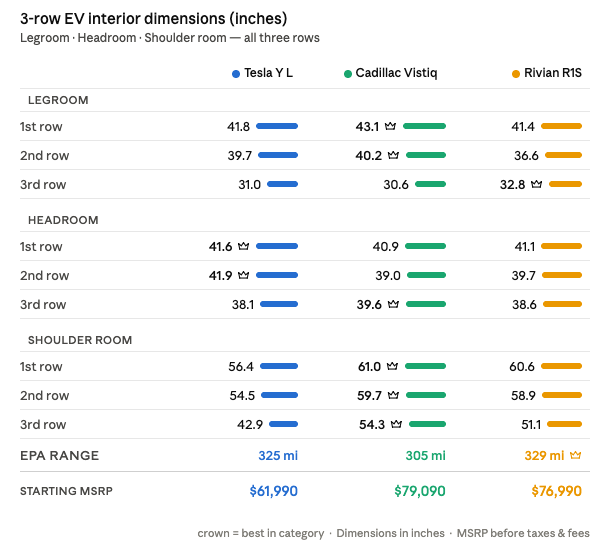
- Tesla Model Y L starts at $61,990.
- Rivian R1S starts at $76,990.
- Cadillac Vistiq starts at $79,090.
That’s a $15,000 to $17,000 gap between Tesla and the field — a difference that buys a lot of home charging equipment, or a home solar system that makes your fuel cost near zero for the next 25 years.
If budget is your primary filter, Tesla wins before you open the door.
Ready to see your numbers?
See your real solar price in 90 seconds
Enter your address — we'll show you the system, savings, and price for your exact roof.
Who wins interior space?
This is where the Cadillac Vistiq surprises people. In a head-to-head comparison across all nine interior measurements — legroom, headroom, and shoulder room across three rows — the Vistiq wins six of nine categories. Its shoulder room is in a different class: 61 inches in the first row versus 56.4 for Tesla and 60.6 for Rivian. For families who spend hours in the car, that extra breathing room is real.
Rivian takes the crown for 3rd row legroom at 32.8 inches versus Tesla’s 31 and Cadillac’s 30.6. If you regularly put adults in the back row, Rivian is the only one that won’t feel like punishment.
Tesla leads on headroom across the first and second rows, which matters more than people think on long drives — tall drivers and passengers will notice.
Range
All three clear 300 miles in EPA-estimated range, which puts range anxiety largely in the rearview mirror for normal family use.
- Rivian leads at 329 miles EPA.
- Tesla follows at 325 miles.
- Cadillac trails at 305 miles.
The practical difference between these numbers for most families is minimal — the more interesting question is how each car charges on a road trip, where Tesla’s Supercharger network still holds a meaningful advantage.
The home energy angle
Here’s what most car comparison articles miss. Every mile you drive an EV is a mile powered by electricity. The average American family drives 15,000 miles per year. At $0.16 per kWh the fuel cost is roughly $900 annually.
Add a home solar system, and the cost drops substantially and is locked in for 25 years regardless of what utilities charge. The Tesla Model Y L, the Cadillac Vistiq, and the Rivian R1S all become dramatically better financial decisions when paired with solar.
The car choice matters less than the energy choice behind it.
The bottom line
The right 3-row EV depends on your priorities:
- Buy the Tesla Model Y L if price and headroom are most important.
- Buy the Cadillac Vistiq if your family values space and you want the most refined interior in the segment.
- Buy the Rivian R1S if you need range, real 3rd row legroom, or any off-road capability.
All three are excellent vehicles, and none of them require a gas station. Add a 3 kW solar system for less than $50/mo and fuel any of these cars with solar for decades. Get complimentary proposals at Solar.com.
Your next step
See exactly what solar costs on your roof
We use satellite data and your utility rates to show a real price and payback — in about 90 seconds, with no sales calls.