How Do Solar Panels Lower Your Electric Bill?
We need electricity for everything from air conditioning and kitchen appliances to TVs and cell phones, and all of that usage adds up. But did you know you can use solar panels to lower your electric bill?
By fixing your electricity costs at a low rate, solar systems are often the best way of reducing your electricity bill without making drastic cuts to your energy usage.
In this article, we'll explore how to use solar panels to lower your utility bill and give you the tools to start saving.
Ready to go solar? Get binding quotes here.
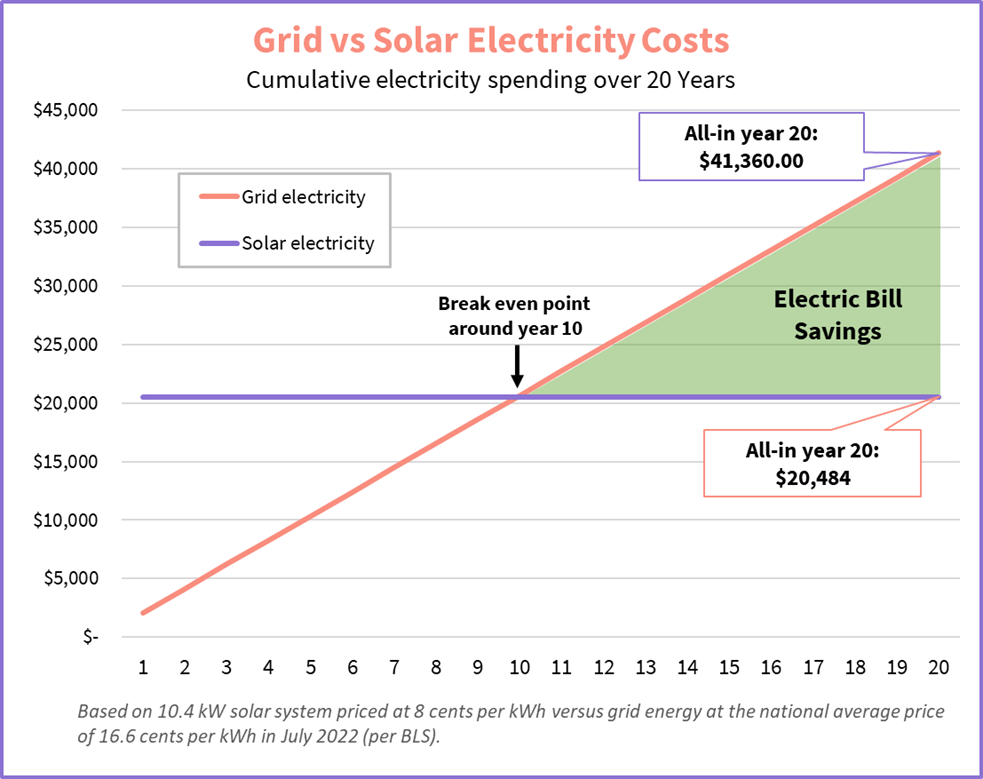 In this scenario, the grid user paid $41,360 for 20 years of electricity, while the solar owner paid $20,484 for 20 years of electricity.
All-in, using solar panels lowered the cumulative electricity bill by $20,876 over 20 years. And the overall savings could be more than that for three reasons:
In this scenario, the grid user paid $41,360 for 20 years of electricity, while the solar owner paid $20,484 for 20 years of electricity.
All-in, using solar panels lowered the cumulative electricity bill by $20,876 over 20 years. And the overall savings could be more than that for three reasons:
How to Lower Your Electric Bill With Solar Panels
To begin, let's identify the three primary problems with electric bills:- They’re expensive
- They’re continually getting more expensive
- They’re unpredictable
Electric Bills Are Expensive
It may not feel like it, but your probably paying way more for grid energy than you would be for solar. The price of electricity is measured in cents per kilowatt-hour (kWh). According to the US Bureau of Labor Statistics, the national average price for electricity in June 2023 was $0.17 per kWh. Meanwhile, with the 30% federal solar tax credit available nationwide, the average price of electricity produced by solar systems purchased through solar.com is between typically around $0.08 per kWh. That's less than half of the national average and nearly four times less than the price of grid electricity in California. It's even lower than the price in Washington State, where electricity is dirt cheap! Related reading: Pros and Cons of Going SolarDo solar panels lower your electric bill?
Solar panels can not only lower your electric bill -- they can completely replace it. Your electric bill depends primarily on two factors:- How much electricity you use
- The rate at which the utility company charges for that electricity
Home solar versus grid electricity
In this scenario, the grid user paid $41,360 for 20 years of electricity, while the solar owner paid $20,484 for 20 years of electricity.
All-in, using solar panels lowered the cumulative electricity bill by $20,876 over 20 years. And the overall savings could be more than that for three reasons:
- Most solar equipment is warrantied for 25 years and lasts much longer than that
- Solar panels increase your home value
- Grid electricity rates increase over time
Ready to see your numbers?
See your real solar price in 90 seconds
Enter your address — we'll show you the system, savings, and price for your exact roof.
Grid Electricity Rates Are Always Rising
Grid electricity rates are already higher than solar, and they will continue to increase over time. By taking these rate hikes into account, solar panels can lower your electric bill even further. In the last 20 years, the price of grid energy has increased 2.79% per year on average, according to the Bureau of Labor Statistics. But in 2022, the average rate increased 12.6% in one year!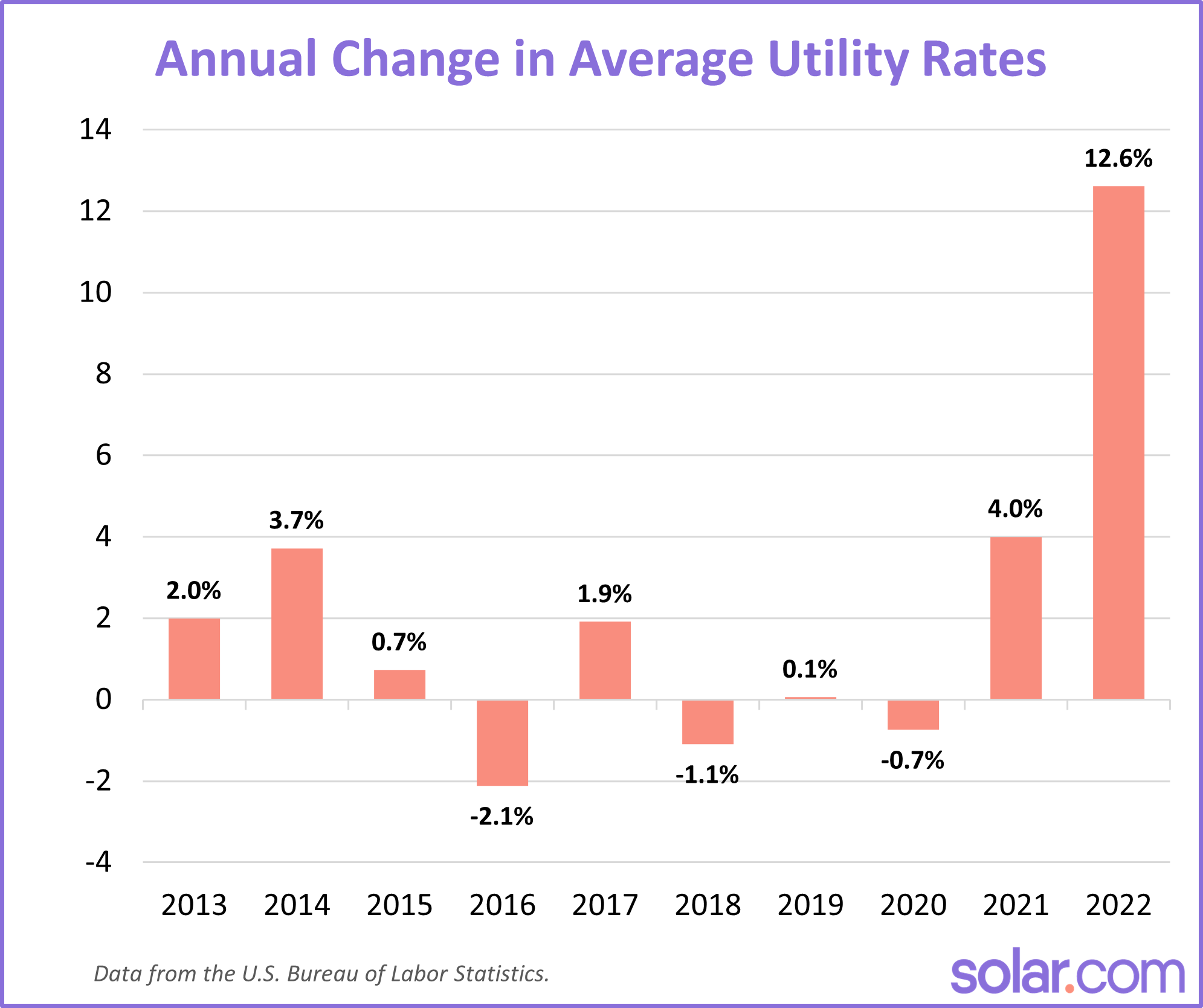 That's a major shock to the system, and the EIA is projecting another above average rate increase of 3.77% from 2022 to 2023.
In the big picture, utility rate increases are the rule -- not the exception to the rule. In fact, the average price of grid electricity has increased in 31 of the last 40 years.
That's a major shock to the system, and the EIA is projecting another above average rate increase of 3.77% from 2022 to 2023.
In the big picture, utility rate increases are the rule -- not the exception to the rule. In fact, the average price of grid electricity has increased in 31 of the last 40 years.
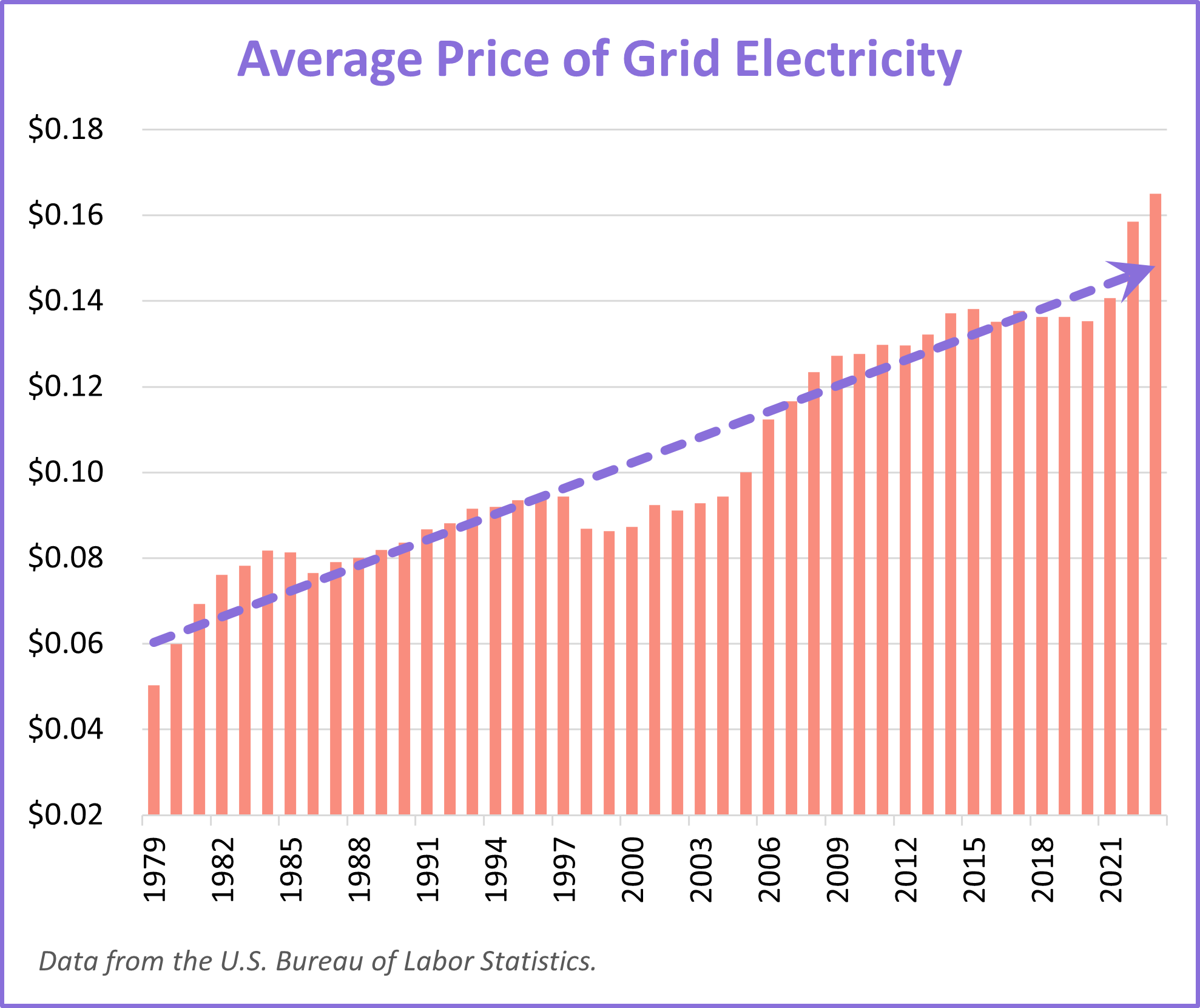 Meanwhile, going solar fixes your electricity costs for the lifetime of the system. So, if you go solar in 2023 at 8 cents per kWh, you'll still essentially be paying 8 cents per kWh in 2043 when grid energy is over 28 cents per kWh (based on 2.79% increase per year -- it could be more!).
Here's how paying for solar versus grid electricity looks over 20 years when accounting for 2.79% rate hikes based on the historical average and 5% rate hikes that are more in line the average rate of inflation.
Meanwhile, going solar fixes your electricity costs for the lifetime of the system. So, if you go solar in 2023 at 8 cents per kWh, you'll still essentially be paying 8 cents per kWh in 2043 when grid energy is over 28 cents per kWh (based on 2.79% increase per year -- it could be more!).
Here's how paying for solar versus grid electricity looks over 20 years when accounting for 2.79% rate hikes based on the historical average and 5% rate hikes that are more in line the average rate of inflation.
Home solar versus grid electricity with rate hikes
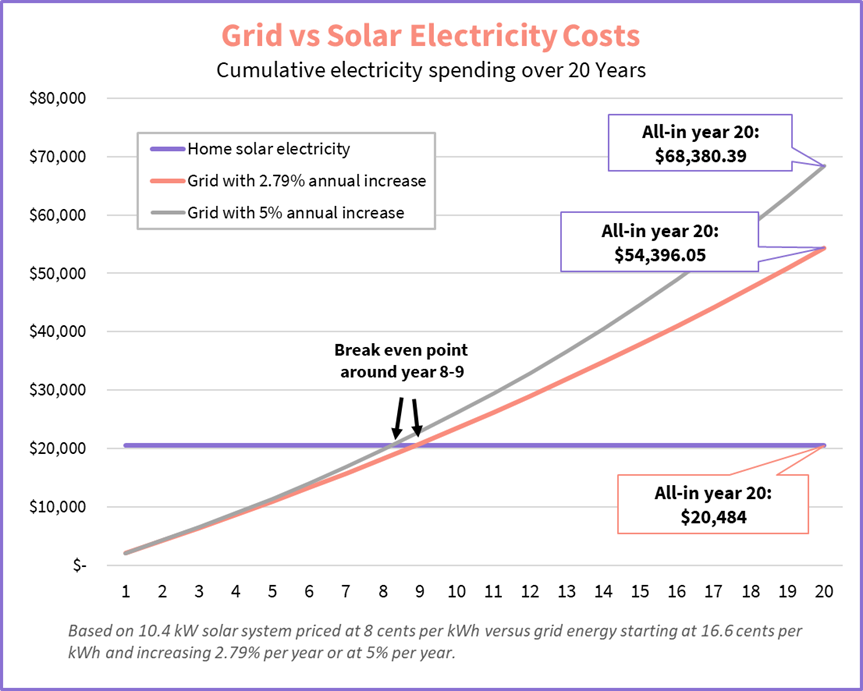 Taking rate hikes into consideration, solar owners would save:
- $33,912.50 over 20 years of 2.79% annual rate hikes
- $47896.39 over 20 years of 5% annual rate hikes
Why do utilities hike electricity rates?
Even as utilities add cleaner, cheaper renewable energy into the electric grid, they face enormous costs to maintain and expand the grid. Since the US was one of the first countries to build out an electric grid, it also means that our system is one of the oldest. Utility companies spend hundreds of millions of dollars every year upgrading their towers, lines, substations, and transformers. These costs continue to drive up the cost of delivering electricity, even as cheaper generation sources come online. Homeowners can lower electric bills with a solar power system. Solar systems have almost no ongoing fuel or maintenance costs – sunshine is free! Solar systems also produce power right where it’s needed (in the home), which avoids costly transmission infrastructure. As grid maintenance costs continue to rise, solar systems will provide increasingly attractive returns.Electric Bills Are Unpredictable
In the last section we used nice, steady rate hikes to show how grid electricity increases over time. But in reality, grid electricity rates are anything but steady. Take a look at this graph of year-over-year electricity price changes since 2019 from MishTalk.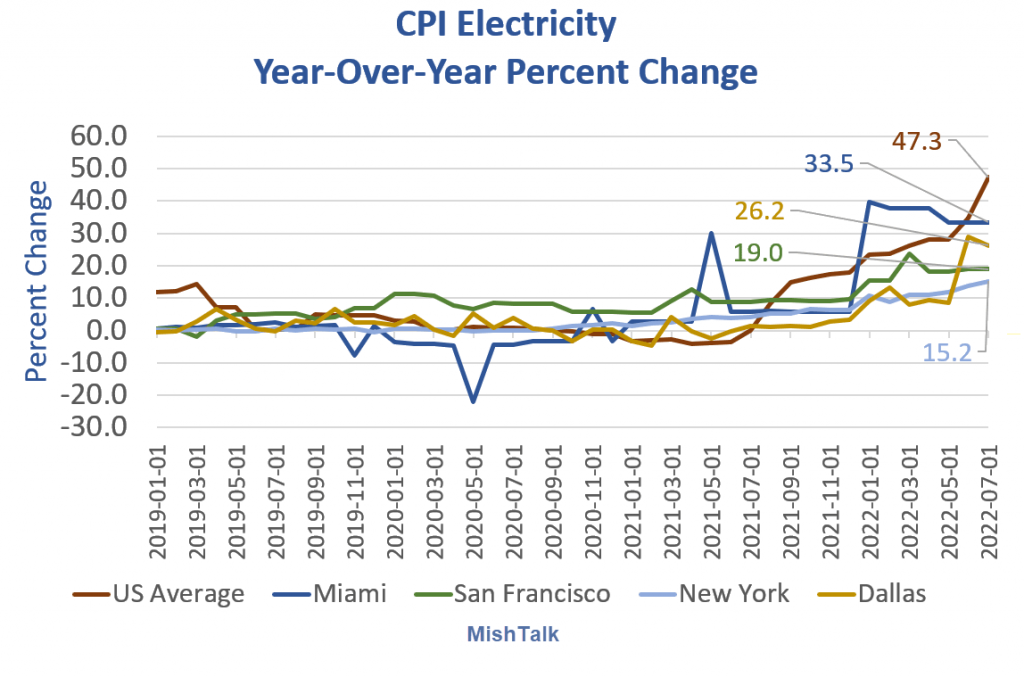 See a pattern? We don't either. It's madness.
But here's the takeaway: The average American paid 47.3% more for grid electricity in July 2022 than they did in July 2021.
Few people, if any, saw that coming.
It's also hard to predict where utility rate hikes will strike next. The map below shows the rise in utility rates from April 2022-April 2023 for each state, which ranged from 33% in New Hampshire to -7% in Louisiana.
See a pattern? We don't either. It's madness.
But here's the takeaway: The average American paid 47.3% more for grid electricity in July 2022 than they did in July 2021.
Few people, if any, saw that coming.
It's also hard to predict where utility rate hikes will strike next. The map below shows the rise in utility rates from April 2022-April 2023 for each state, which ranged from 33% in New Hampshire to -7% in Louisiana.
Skip the guessing game with solar
With solar, energy costs are extremely predictable. Many homeowners are able to cover 100% of their energy needs with their solar system, in which case they will typically only have a $10-20 minimum service charge from the utility that goes towards grid maintenance fees, charges for net metering, and other associated costs. If the solar system doesn’t cover 100% of their needs, then they will have some level of remaining electric bill that will vary through the year. With a cash purchase, there’s no recurring cost for the system or power. With financing, there’s a set monthly payment that doesn’t vary based on season or immediate usage. Either way, this stability can be very valuable for homeowners budgeting their monthly expenses.Lower your electric bill with solar panels
To recap, solar panels do two things to reduce your electric bill:- They set the price you pay for electricity lower than what you would pay on the grid (~8 cents per kWh for solar versus the national average 16.6 cents per kWh for grid)
- They shield you from the ever-rising cost of grid electricity
More in How Do Solar Panels Lower Your Electric Bill?
Solar Just Beat Coal and Wind: Will That Lower Your Energy Bill?
Sam Wigness·
This Energy Bill Tip Gets Overlooked: Reduce Your Rate, Not Your Comfort Level
Sam Wigness·
2026 SCE Time-Of-Use (TOU) Rates: A Beginner’s Guide
Sam Wigness·
How Much Does Electricity Cost in Your State?
Sam Wigness·
How Much Have Electricity Prices Increased in 2025?
Sam Wigness·
Why Electricity Costs Are Rising in 2025 and Where They Are Rising Fastest
Sam Wigness·
What’s The Average Electric Bill in 2026 And How Does Yours Compare?
Sam Wigness·
Why Is My Electricity Bill So High in 2026?
Sam Wigness·
These 13 States Will See Electricity Bills Soar this Summer — Here’s Why
Sam Wigness·
Con Edison Electricity Rates Are Rising – Here’s How Solar Can Help
Sam Wigness·
Will Electricity Prices Go Down in 2026?
Sam Wigness·
What’s the Average Electric Bill for a 3 Bedroom House?
Sam Wigness·
What’s the Average Electricity Bill for a 2 Person Household in 2026?
Sam Wigness·
Con Edison Electric Rates in 2024: Plans, Rate Hikes, and Lowering Your Bill
Sam Wigness·
Should CA Solar Owners Be Worried About Income Based Electricity Bills?
Sam Wigness·
PG&E Electric Rates in 2026: Peak Hours & Rate Plans
Sam Wigness·
2024 SDG&E Electric Rates: How To Lower Your Electricity Costs in San Diego
Sam Wigness·
How Much Is The Average Electric Bill in California?
Sam Wigness·
Understanding Your Electric Bill Before and After Going Solar
Isaac Ost·
Why Is My Electric Bill So High With Solar Panels?
Sam Wigness·
How Do You Calculate The Number of Panels on a 16 kW Solar System?
Ryan Nixon·
What Is the Average Monthly Electric Bill With Solar Panels?
Sam Wigness·
What Uses the Most Electricity in a Home?
Sam Wigness·
How To Cut Your Electric Bill by 75 Percent
Sam Wigness·
How Many kWh per Day Is Normal?
Sam Wigness·
How To Lower Your Electric Bill With Solar Panels
Sam Wigness·
5 Reasons Solar Panels Are Worth It in Boston
Sam Wigness·
Is Solar Still Worth It With NEM 3.0 in California? 5 Ways To Maximize Your Savings
Sam Wigness·
6 Reasons You Should Buy Solar Panels
Johanna Poole·
Top Reasons Why You Should Go Solar Before 2022
Hannah Glenn·
The Top 5 Reasons To Go Solar in 2021
Sam Baker·
The Impact of SCE’s Rate Changes
Patrick Crowley·
San Diego Gas and Electric (SDG&E) proposes a 28% rate hike over four years
Sushma Raj·
PG&E Raised Prices 4% Annually on Average to Discourage High Users
Stephanie Hauschildt·
Here’s How to Understand Your PG&E Bill After Going Solar
Isaac Ost·
A History of Con Edison’s Electricity Rates
Isaac Ost·
SoCal Edison Electricity Rates Increase in 2018 & 2019
Isaac Ost·
Your Life Once You Go Solar
Isaac Ost·
The Top 10 Benefits of Switching to Solar
Guest Contributor·
10 Tips To Lower Your Electric Bill
Michael Olenick·
Northern California’s Electricity Rates Jumped 21% in 2016
Michael Olenick·
PUC Decision May Signal Demise of Nevada Solar
John Kennedy·
Outrage over NV Energy “Bait and Switch”
John Kennedy·
Salt River Project Rate Hikes Threaten Arizona Solar Viability
John Kennedy·
Wind Power vs. Solar Power
Sam Baker·
So Cal Residents Turn to Solar as Energy Costs Rise; KTLA Money Smart
Sam Baker·
Your next step
See exactly what solar costs on your roof
We use satellite data and your utility rates to show your price and payback in about 90 seconds, with no sales calls.