Buy Solar Panels
How to Buy Solar Panels
Buying solar panels is something homeowners do once, maybe twice, in a lifetime. As such, the process can be a little intimidating and it can be tough to know where to begin. So, in this article we’ll break down the basics of buying solar panels for your home. We’ll cover:- How to buy solar panels
- Leasing vs buying solar panels
- Where to buy solar panels
- Buying a house with solar panels
- The best solar panels to buy
How to buy solar panels: Cash vs loan
If you plan to buy solar panels, one of the first things to consider is whether you’ll purchase them with cash or finance them with a loan. While a cash purchase leads to greater lifetime savings, financing with a solar loan can lead to more immediate savings. Typically, about half of solar.com customers chose to pay cash and the other half chose to finance with a solar loan.| Cash advantages | Loan advantages |
| Greater lifetime savings | More immediate savings |
| No interest payments | Zero down payment |
| Not subject to loan approval qualifications | Steady, predictable electricity costs |
- Paying cash (purple line) leads to ~$4,500 in additional energy cost savings, but it takes around 7 years to break even
- The 12-year solar loan (pink line) offers immediate monthly savings, but includes ~$4,500 in interest payments
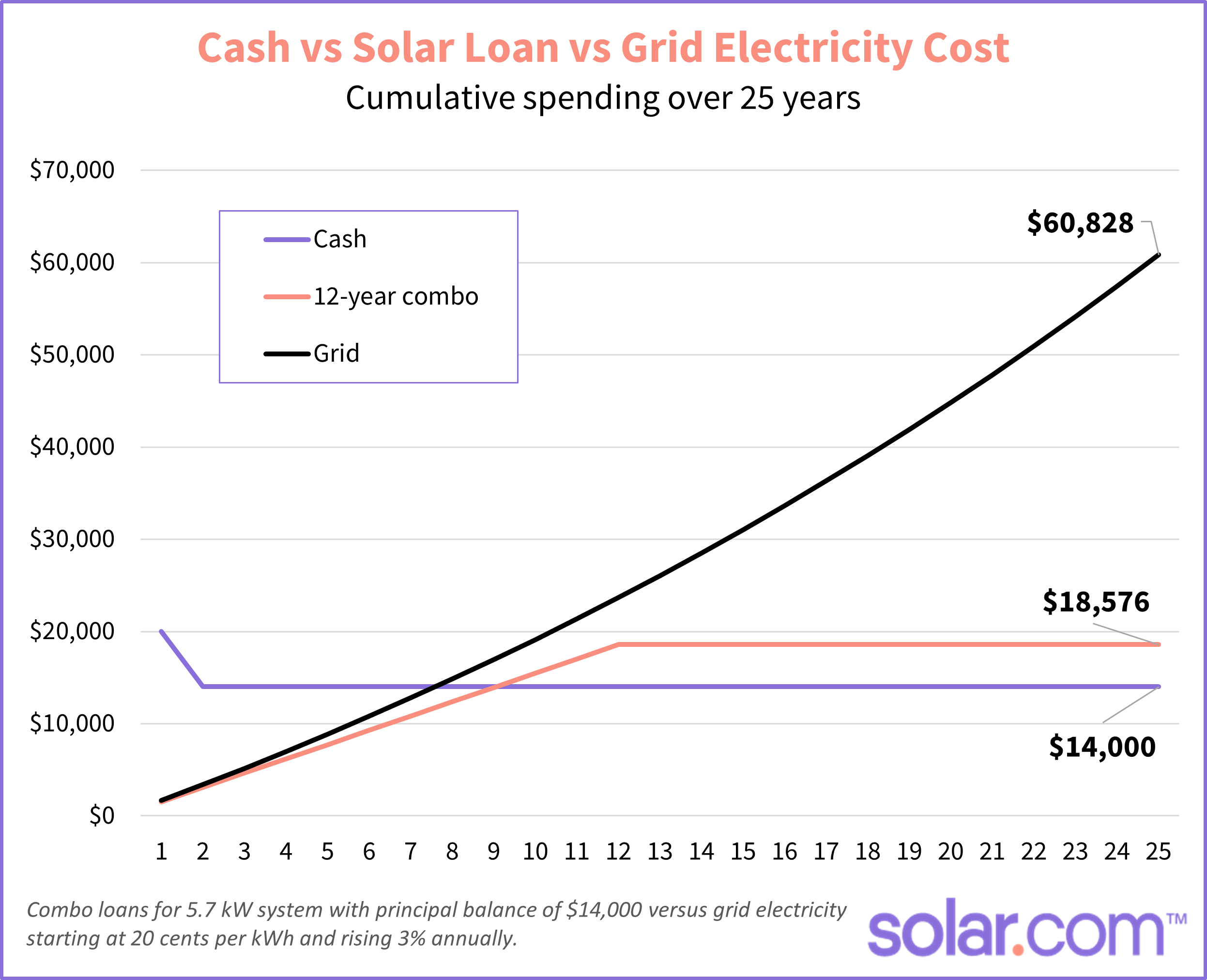 How you choose to buy solar panels depends on your financial situation and your savings goals.
Buying solar panels with cash
Paying cash is the simplest way to buy solar panels and offers the greatest return on investment. Cash purchases are typically made in 3-4 installments. For example:- Down payment/deposit - An initial deposit upon signing a contract in order to lock in an installation date
- Due upon delivery of materials - A second installment around 50% of the remaining balance is due when equipment is delivered and/or installation begins
- Due upon final inspection - The remaining balance is due once your system is installed and passes city building inspection
Buying solar panels with a loan
Let’s face it, not everybody has $20,000 to $30,000 in cash lying around – but that doesn’t mean you can’t buy solar panels. Solar loans offer a steady monthly payment that can front-load your solar savings. For example, if your average electricity bill is $125 a month and your solar loan payment is $100 a month, you’re saving $25 a month ($300 per year) right off the bat. The great thing about solar loans is that they are incredibly versatile and loan terms range from 8 to 20 years. In addition, most solar loans do not require a down payment, although you can make one to lower your monthly payments. So, by mixing and matching the type of loan, the term, and your down payment, you have a lot of control over your monthly electricity costs. As a rule of thumb:- Longer loan term equals lower monthly payments but more money spent on interest
- Shorter loan term equals higher monthly payments and less money spent on interest
Where to get a solar loan
There are a few ways to find a lender for your solar loan.- Find one yourself (Google, use your primary bank, call around)
- Use the lender your solar installer recommends
- Team up with a solar.com Energy Advisor to shop for loan options
Solar loan qualifications
Like a mortgage or a car loan, you’ll need certain qualifications to be approved for a solar loan. Loan qualifications vary by lender, but typically you’ll need:- A FICO credit score above 650
- A debt-to-income (DTI) ratio below 50%
- The primary borrower on the loan must have their name on the title of the home getting solar panels
Ready to see your numbers?
See your real solar price in 90 seconds
Enter your address — we'll show you the system, savings, and price for your exact roof.
Leasing vs Buying Solar Panels in 2026
Now that we know the basics of buying solar panels, let’s explore the advantages of buying versus leasing your solar system. The major difference is who owns the system.- If you buy solar panels – either with cash or a loan – you own them
- If you lease solar panels, someone else owns them
| Advantages of buying solar panels | Advantages of leasing solar panels |
| Greater energy cost savings | Lease provider responsible for monitoring & maintenance |
| Increases home value | No or low upfront cost |
| You claim local tax credits & incentives | Low, predictable monthly payments |
| Easier to transfer in home sale | Federal tax credit (claimed by installer) available through end of 2027 |
Where to buy solar panels
In most cases, residential solar panels are bought through an installation company, just like kitchen cabinets are typically ordered through a contractor. There are hundreds different models of solar panels available through solar.com’s network of installers. By easily comparing quotes from local installers, homeowners have access to a tremendous variety of solar panels, inverters, and batteries. While it is possible for homeowners to buy solar panels themselves, either used or directly from the manufacturer, there are a few reasons to buy them through an installer.- Solar installers have relationships with manufacturers that allow them to get better pricing than homeowners
- Unlike used panels, new solar panels come with 25-year warranties that are crucial to protecting your investment
- Installers have reliable shipping methods and will deal with shipping and handling issues if they arise
Buying a house with solar panels
The back way into buying solar panels is buying a house that already has solar panels installed. According to Zillow, homes with solar panels – and other energy efficient features – sell faster and for more money than comparable homes without. And why wouldn’t solar panels be an attractive feature? You’re essentially buying a house with incredibly low electricity costs and saving money on energy the day you sign the deed. There are a few things to consider when buying a house with solar panels:- Is the system owned or leased? If the home has a leased system, are you prepared to take over the lease payments, or would you rather have the owner pay off the lease and remove the system?
- Is the roof in good condition? One of the drawbacks of rooftop solar is that the system needs to be removed in order to re-roof the house, which costs money. If the roof seems old, it may be worth negotiating over.
- Will the system cover your electricity needs? If you will use substantially more electricity than the previous owner (say, by charging an EV at home), then the existing system won’t cover 100% of your consumption. That shouldn’t be a deal-breaker, but it’s worth considering.
- Will the warranties transfer over? In most cases, the performance and product warranties will transfer in a home sale and continue protecting the system. However, it’s worth establishing that during the sale.
Best solar panels to buy
There are thousands of residential solar panel models that range in size, efficiency, power output, price, and warranty coverage. The best solar panels to buy depend on your budget, priorities, and energy goals. Most homeowners look for a balance of efficiency, affordability, and warranty coverage. Based on thousands of sales over a 12-month period, REC was the most popular brand of solar panel, followed by Q Cells, Panasonic*, SEG Solar, Canadian Solar, and Solaria. *Panasonic exited the solar module manufacturing space in 2025 and the availability of these panels will be limited moving forward.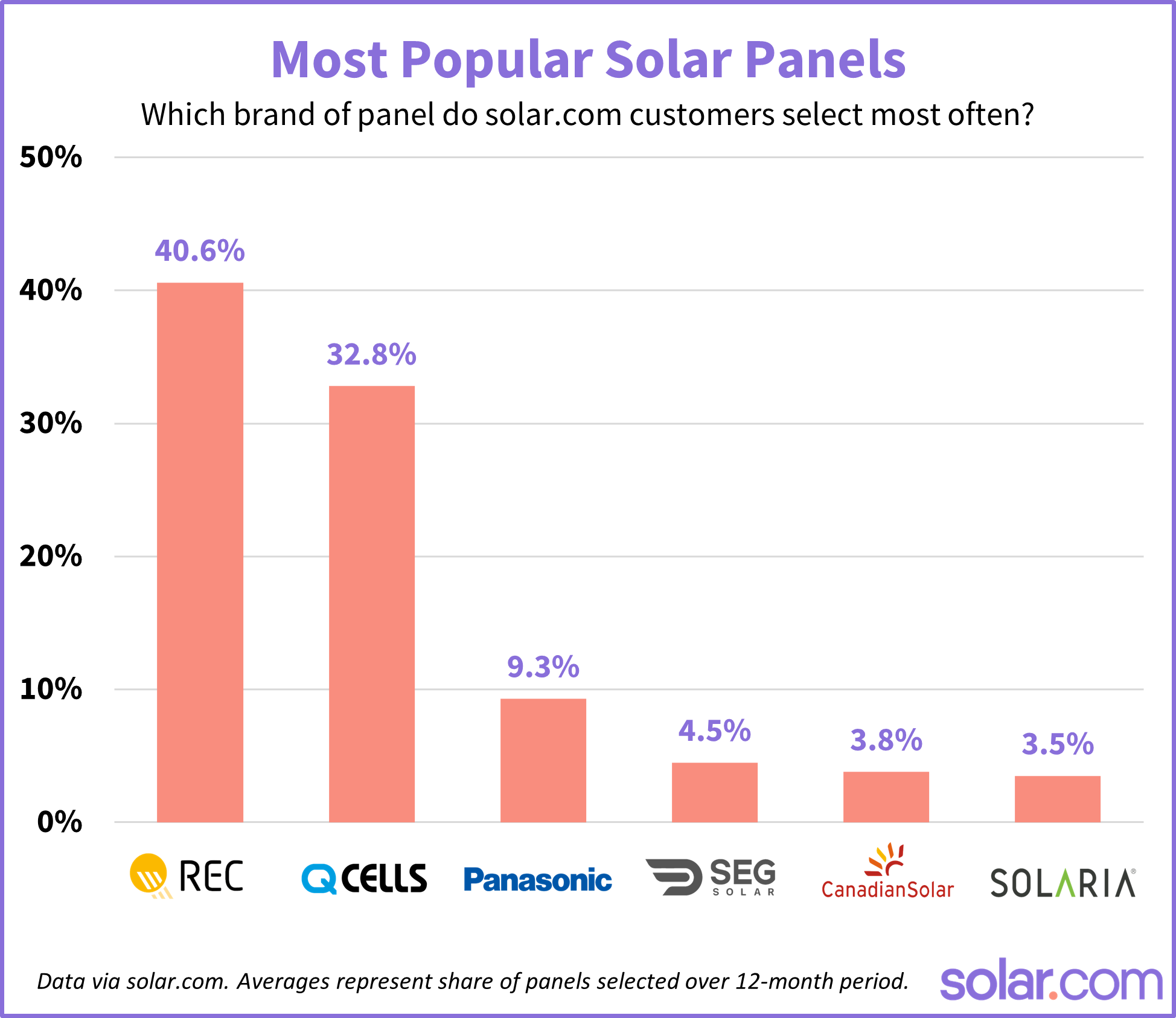 Some things to consider when you’re choosing a solar panel model:
- The size of your roof. If you have a limited roof space, you may need panels with higher efficiency and power output
- Manufacturer warranties. Most panels have 25- to 30-year performance warranties that guarantee a certain level of output over time
- Black vs blue. Monocrystalline panels tend to be black in color while polycrystalline panels tend to be blue in color
- Where it’s made. With incentives from the Inflation Reduction Act, more solar panels are being manufactured in the US
| Category | Panel(s) | Measurement |
| Lowest degradation | SunPower X-Series, Panasonic EverVolt, REC Alpha | No more than 0.25% per year |
| Most efficient | SunPower A-series | Up to 22.8% |
| Longest performance warranty | Aptos Solar DNA Split Cell Series, Hyundai RG Series, Canadian Solar (various models) | 30 years |
| Locally made | Silfab mono series, Q Cells Peak Duo series, Mission Solar PERC series, Solaria Power XT series | Manufactured in the USA |
The bottom line
Between incentives, zero-down financing, and plummeting prices, the cost of going solar is nowhere near the barrier it once was. In fact, just figuring out how to buy solar panels is often a bigger hurdle than actually buying them. Solar.com simplifies the process of buying solar panels by pairing you with an expert Energy Advisor to guide you every step of the way. Better yet, studies by the US Department of Energy have proven that homeowners save money by comparison shopping on solar.com. Compare multiple quotes and see how much you can save by going solar today.More in Buy Solar Panels
Is Prepaid Solar Better than the Original Tax Credit?
Brian Lynch·
Is It Better to Lease Or Buy Solar Panels?
Sam Wigness·Buying Solar Panels vs. Leasing Solar Panels
Sam Baker·
5 Common Ways to Finance Solar and Storage Systems
Mattea Jacobs·
All You Need To Know About Solar Home PACE Financing
Isaac Ost·
Is Bitcoin Mining Sucking the Energy Market Dry?
Hannah Glenn·
SolarCoin, an Energy Cyptocoin with a Bright Future
Sam Wigness·
Mass Solar Connect Extended to November 30th
Kyle Cherrick·
What to Expect from a Solar Contract
Michael Olenick·
The Future of Solar Energy Under The Trump Administration
Sam Wigness·
Solar Purchasing Options Got You Confused?
Sam Baker·
Your next step
See exactly what solar costs on your roof
We use satellite data and your utility rates to show a real price and payback — in about 90 seconds, with no sales calls.