What California Homeowners Need to Know about the RSSE Program in 2026
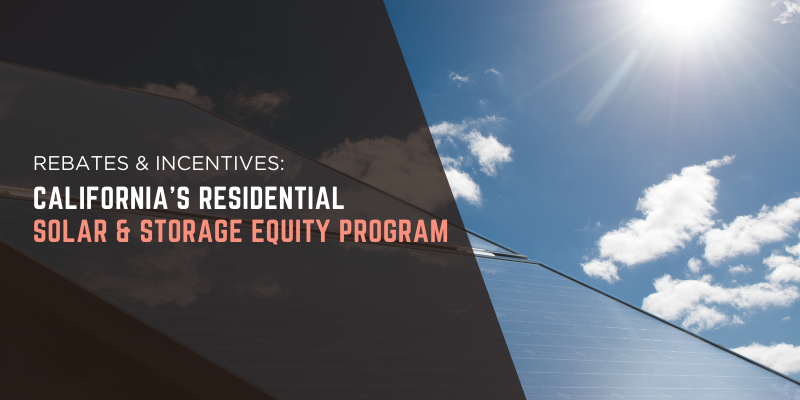
With the 30% federal solar tax credit officially expired for customer-owned systems, many Californians are interested in other rebates and programs to help lower the cost of going solar. For those who qualify, the Residential Solar and Storage Equity (RSSE) program offers rebates that can cover up to 100% of the cost to install solar and battery storage.
If you don’t qualify, solar.com recommends looking into “prepaid” third-party owned systems, which are still eligible for a federal tax credit through 2027 and provide flexibility similar to owning the system outright.
Let’s explore the RSSE program to see if this is a good fit for your home.
Jump ahead:
What is RSSE rebate program?
Who is eligible for the RSSE program?
The RSSE program is available to California residential customers who meet income requirements or live in disadvantaged communities. Eligible households must be installing a home battery system at their primary residence and qualify under California’s low-income or equity guidelines, such as CARE, FERA, or approved community-based criteria.
To qualify under RSSE, the project must:
- Include battery storage (solar may also be included)
- Meet SGIP equipment, sizing, and performance standards
- Be permanently installed and operate for at least 10 years
- Comply with SGIP rules on cycling, monitoring, and emissions
Importantly, customer ownership is not required for RSSE eligibility, which means leases, Power Purchase Agreements, and prepaid systems can qualify. However, the system owner is the one who receives the benefit.
Single-family home RSSE eligibility
A household qualifies if either of the following is true:
- Household income is at or below 80% of Area Median Income (AMI), verified using HUD income guidelines; or
- The household already qualifies for an approved low-income program, such as:
- CARE
- FERA
- SASH or DAC-SASH
- ESA (Energy Savings Assistance)
For example, a household of four in Riverside County could qualify by verifying an income at or below $72,000, or if they have already done so by enrolling in one of the programs listed above.
Multifamily home RSSE eligibility
A multifamily residential building can qualify for RSSE through the following pathways:
| Pathways | Criteria 1 | Criteria 2 |
| Pathway 1 | The building has at least 5 rental units operated to provide deed-restricted low-income housing, and | Is located in a disadvantaged community specified by CalEnviroScreen |
| Pathway 2 | The building has at least 5 rental units operated to provide deed-restricted low-income housing, and | Is a building where 80% of households have incomes at or below 60% of AMI via HUD income guidelines. |
| Pathway 3 | Have reserved funds in the MASH, or SOMAH programs; or are enrolled in MASH successor tariffs |
No second criteria required |
Ready to see your numbers?
See your real solar price in 90 seconds
Enter your address — we'll show you the system, savings, and price for your exact roof.
RSSE rebate amounts
The RSSE program can save homeowners $3.10 per Watt off solar and $1.10 per Watt-hour off batteries. In many instances, these rebates can fully pay for the system.
For instance, an average-sized residential system with 7 kW solar and 10 kWh of battery storage would qualify for $21,700 for solar and $11,000 toward battery storage.
There are some system requirements that can affect your rebate amount:
- The system must be sized to the home’s actual electricity usage (no oversizing without justification).
- Batteries larger than 15 kWh for single-family homes must be justified by the home’s energy usage.
- The battery rebate can only be used in conjunction with solar; however, battery retrofits for existing solar may be eligible, provided they are sized to average evening electricity usage.
Protect Yourself from Bad Actors
Given the generous rebates available through the RSSE program, it’s disappointing, but not surprising, that companies try and exploit the RSSE incentives through misleading marketing and advertising. Homeowners have reached out to solar.com Energy Advisors with pamphlets and mailers from other companies that appear to be coming directly from the utility, promoting RSSE.
These homeowners are smart for checking with a third-party authority to gauge the validity of marketing. While the RSSE program is very real, its restrictions and rules are complex. Working with a trustworthy company—and not one that lies about who they are—is key to a successful project.
Have questions about RSSE or want to check your eligibility? Schedule a time to meet with a solar.com Energy Advisor for a hassle-free consultation.
Your next step
See exactly what solar costs on your roof
We use satellite data and your utility rates to show your price and payback in about 90 seconds, with no sales calls.